
Free Embroidery Patterns for Every Crafter
Where can you find high-quality embroidery designs without paying a cent? Free embroidery patterns are easier to access than ever, with countless creators sharing stitch patterns online. These resources let crafters explore new techniques without financial risk. From floral motifs to intricate animals, the variety is surprising. No hidden fees, no memberships—just immediate access to creative inspiration.
More people are turning to DIY embroidery art as a way to unwind and create something tangible. Search traffic for terms like needlework templates and cross-stitch charts has risen steadily over the past two years. Crafters on social media swap hand embroidery patterns like trading cards. Even beginners can start a project tonight with just a hoop and thread. The digital stash of stitchable art grows every day, quietly reshaping how creativity spreads.
Where to Find Reliable Sources for Free Embroidery Patterns
For crafters looking to start or expand their collection of hand embroidery patterns, knowing where to look is half the battle. The internet is flooded with resources, but not all offer high-quality, printable, or beginner-friendly designs. The best sources provide a range of styles—from traditional folk motifs to modern minimalist art—and ensure files are available in accessible formats like PDF, SVG, or PNG. Whether you're drawn to floral borders, animal silhouettes, or seasonal themes, identifying trustworthy platforms saves time and prevents frustration from broken links or low-resolution images.
Top Websites Offering Curated Embroidery Designs
Several online hubs have built reputations for consistently delivering well-organized and visually appealing DIY embroidery art. Craftsy and Pinterest serve as major discovery engines, though they primarily aggregate content rather than host original patterns. For direct downloads, DMC’s official website stands out, offering professionally designed cross-stitch charts and surface embroidery templates aligned with their thread color guides. These are especially helpful for matching floss shades accurately, a critical detail for polished results.
Another trusted name is Needles ‘n’ Thread, a long-running blog run by embroidery expert Mary Corbet. Her site features free stitch patterns tailored to educational tutorials, often including step-by-step photos and technique breakdowns. Unlike many crowd-sourced platforms, her content emphasizes craftsmanship over trend-chasing, making it ideal for intermediate stitchers looking to improve skills while using reliable needlework templates.
- Project Linus Craft Guild: Offers seasonal embroidery designs focused on charity crafting, including child-friendly motifs and simple outlines perfect for beginners.
- FreeEmbroidery.com: A no-frills archive with over 1,200 categorized designs, from alphabets to holiday themes, all downloadable without registration.
- Library of Congress Digital Collections: A lesser-known but rich source of public domain patterns from the early 20th century, ideal for vintage-inspired projects.
- Reddit communities like r/Embroidery: Members frequently share personal creations and link to free downloadable stitch patterns in discussion threads.
Open-Source Platforms and Creative Commons Resources
Open-source design platforms such as OpenClipArt and Inkscape’s resource library have become go-to destinations for customizable embroidery designs. These sites host vector-based files released under Creative Commons licenses, meaning users can legally modify, resize, and even sell items made from the patterns—as long as credit is given when required. This flexibility makes them particularly valuable for small business owners or makers selling hand-stitched goods on Etsy or similar marketplaces.
Platforms like GitHub have also seen niche embroidery collectives uploading digital repositories of machine-readable stitch files. While these cater more to machine embroidery users, many include companion hand-stitch versions. One notable example is the “Embroidermodder” project, which converts classic artwork into stitchable formats using open-source software. These resources reflect a growing movement toward democratizing craft knowledge, ensuring that access to quality needlework templates isn’t limited by geography or income level.
- Public domain archives: Sites like the Victoria and Albert Museum’s online collection offer high-res scans of antique embroidery samplers that can be traced and adapted into new hand embroidery patterns.
- Wikimedia Commons: Searchable database with filters for license type; ideal for finding culturally diverse motifs from global textile traditions.
- FreePatternCenter: Aggregates user-submitted designs with clear licensing labels, helping crafters avoid copyright issues when sharing or selling finished pieces.
How to Choose the Right Stitch Patterns for Your Skill Level
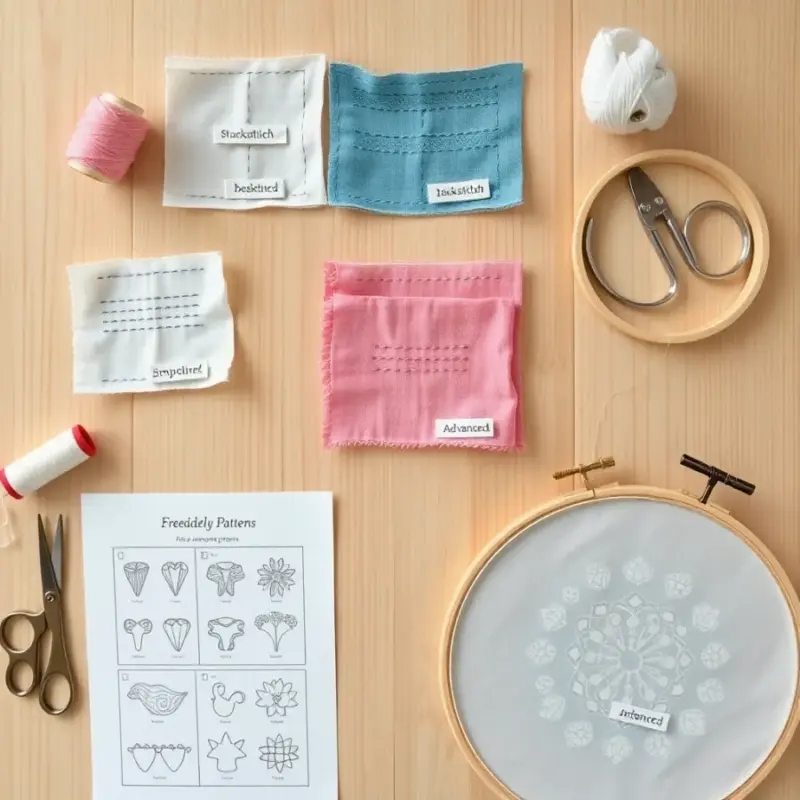
Selecting appropriate embroidery designs based on your current abilities ensures a satisfying, frustration-free experience. Many beginners dive into complex floral mandalas or intricate wildlife scenes only to become overwhelmed by dense stitching areas or unfamiliar techniques. Matching design complexity to skill level improves completion rates and builds confidence. Fortunately, most reputable sites now include difficulty ratings, required stitches, and estimated project times—key indicators for informed decisions.
Beginner-Friendly Embroidery Designs and What to Look For
For newcomers, the best free embroidery patterns use a limited color palette (ideally five colors or fewer) and rely on foundational stitches like the backstitch, satin stitch, and French knot. Simple outlines, geometric shapes, and bold lettering are hallmarks of beginner-appropriate cross-stitch charts. Look for designs labeled “easy,” “starter,” or “first project” and check whether they come with a stitch guide or thread key. Some websites even offer printable practice sheets that pair with specific patterns, letting you test techniques before committing to the final piece.
Another important factor is scale. Smaller designs (under 4 inches in diameter) allow for quicker completion, which helps maintain motivation. Free downloadable samplers from organizations like the Embroiderers’ Guild of America often include progressive lessons, starting with basic lines and advancing to filled shapes within a single PDF. These curated sets act as both pattern collections and learning tools, making them far more valuable than standalone images with no instructional context.
- Stitch count density: Low-density patterns with ample background space are easier to execute cleanly.
- Color-coding clarity: High-contrast thread numbers or labels help prevent mistakes during long stitching sessions.
- PDF layering: Advanced files may separate outline and fill layers, allowing users to print only the sections they need.
Intermediate to Advanced Hand Embroidery Patterns
As skills develop, crafters often seek more detailed stitch patterns that incorporate shading, texture variation, and mixed-media elements. Intermediate designs may include realistic portraits, botanical illustrations with gradient effects, or narrative scenes requiring careful thread blending. At this level, familiarity with specialty stitches—such as bullion knots, couching, or seed stitching—becomes essential. Many advanced patterns assume prior knowledge, so tutorials aren’t always included, but the payoff is higher artistic expression and gallery-worthy results.
One key differentiator at this stage is file quality. High-resolution downloads (300 DPI or higher) ensure crisp transfer to fabric, especially when using transfer pens or iron-on stabilizers. Vector formats (SVG, EPS) allow infinite scaling without pixelation, which is crucial for large hoop art or wall hangings. Some designers offer layered SVG files compatible with cutting machines like Cricut or Silhouette, enabling precise fabric prep before any needle touches thread.
| Skill Level | Recommended Pattern Traits | Common File Formats | Estimated Completion Time |
|---|---|---|---|
| Beginner | Single-line outlines, minimal colors, clear borders | PNG, PDF | 2–6 hours |
| Intermediate | Multiple stitch types, moderate detail, color blending | PDF, SVG, JPG | 8–20 hours |
| Advanced | Photorealistic shading, complex layering, mixed techniques | SVG, AI, layered PDF | 20+ hours |
| All Levels | Seasonal themes, typography, abstract shapes | JPG, PDF, PNG | Variable |
How to Use and Customize Free Embroidery Patterns Effectively
Accessing cross-stitch charts is only the first step—knowing how to adapt and apply them determines the success of your project. Many free downloads come in standard sizes and fixed layouts, but personalizing dimensions, colors, or composition enhances creative ownership. Whether transferring a design to fabric or modifying it digitally, understanding basic preparation methods ensures clean, professional outcomes. With the right tools and workflow, even simple templates can evolve into unique works of DIY embroidery art.
Transferring Designs to Fabric: Methods Compared
Before stitching begins, the pattern must be accurately transferred onto fabric. Several methods exist, each suited to different materials and project types. The most popular technique is the iron-on transfer pen or pencil, which allows you to trace a mirrored version of the design and then heat-set it onto cotton or linen. This method works best with bold, line-based embroidery designs and avoids the mess of carbon paper.
- Print or trace the pattern in reverse (mirror image), especially if text or directional elements are involved.
- Place the transfer paper (shiny side down) on the fabric and position the printed design on top.
- Trace over all lines firmly with a stylus or ballpoint pen to transfer the image.
- Remove the paper and inspect for completeness; retrace any faint sections.
- For washable transfers, test a small area first to ensure the mark disappears after stitching.
Alternative approaches include using water-soluble stabilizers, which are placed under lightweight fabrics and dissolve when rinsed post-completion. These are ideal for delicate garments like baby clothes or sheer scarves where back marks would be visible. Another option is the prick-and-pounce method—an old-school technique involving poking holes along the design lines and dusting chalk or pigment through them. Though time-consuming, it remains popular among historical reenactors and traditional artisans.
Customizing and Scaling Needlework Templates Digitally
Digital customization empowers crafters to resize, recolor, or combine multiple stitch patterns into cohesive compositions. Free tools like Inkscape (vector-based) and GIMP (raster-based) allow users to edit SVG and PNG files without purchasing expensive software. For example, you can import a floral border template, scale it to fit a tote bag panel, and insert a monogram in a complementary font—all before printing.
When resizing, maintain aspect ratio unless intentionally distorting for effect. Avoid enlarging low-resolution JPGs excessively, as this leads to pixelation and jagged edges. Instead, redraw critical lines using vector tools for smooth curves. Recoloring thread palettes is equally powerful: change a spring-themed pattern to autumn hues simply by adjusting color codes to match available DMC or Anchor threads. Many crafters create mood boards alongside their modified designs, pairing fabric swatches and floss reels for visual planning.
- Layer management: Use separate layers for outlines, fills, and text to enable selective printing or editing.
- Grid alignment: Enable pixel or inch grids in design software to keep elements evenly spaced and symmetrical.
- Test prints: Print full-size drafts on regular paper to check proportions before transferring to fabric.
- SVG optimization: Simplify node paths to reduce file size and improve compatibility with cutting machines.
For machine embroiderers repurposing hand-stitch templates, conversion tools like InkStitch (a free plugin for Inkscape) translate vector artwork into stitch commands. While this doesn’t replace handwork, it bridges digital and analog crafting, enabling hybrid projects such as machine-outlined motifs with hand-finished details. This synergy reflects the evolving landscape of embroidery in 2026, where accessibility, personalization, and technical fluency converge to expand creative possibilities for all skill levels.
More Information
Where can I find reliable sources for free embroidery designs online?
You can discover high-quality embroidery designs on craft blogs, digital libraries, and maker communities that specialize in DIY embroidery art. Always check the usage rights to ensure the needlework templates are truly free for personal or commercial use.
Are free hand embroidery patterns suitable for beginners?
Yes, many hand embroidery patterns are designed specifically for newcomers, featuring simple stitches and clear layouts. Look for beginner-friendly stitch patterns that include step-by-step instructions and minimal color changes.
Can I use free cross-stitch charts for craft projects or resale?
It depends on the license—some cross-stitch charts allow personal use only, while others permit crafting items for sale. Always review the terms attached to the DIY embroidery art before using it commercially.
How do I download and print needlework templates correctly?
Look for PDF downloads of needlework templates and print them at 100% scale to maintain proper dimensions. For best results, use a high-resolution printer and test on scrap paper before transferring stitch patterns to fabric.
Leave a Reply